Public transport
Shared passenger transport on fixed routes and schedules.
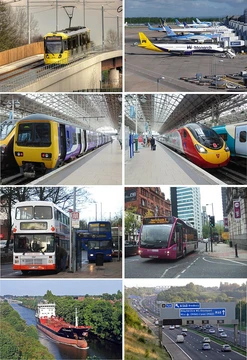
Public transport—also called mass transit, public transportation, or simply transit—covers any shared transportation service available to the general public. These services usually run along set routes and follow published schedules, with passengers paying a standard fare meant to help cover costs, though public subsidies often make up the difference. Exactly which modes count as public transport isn't strictly defined everywhere: buses, railways, trams, light rail, rapid transit, passenger trains, and ferries are typical examples, while air travel is often left out of general discussions because of its market-driven pricing and competitive structure.
Most public transport operates on fixed corridors with designated stops and timetables, which makes operations predictable and infrastructure use efficient. On high-frequency lines, maintaining regular intervals between vehicles often matters more than sticking to exact departure times. Many trips involve more than one mode—walking or taking a feeder bus to reach a train station, for instance—so network coordination and cost-effective planning are key. In some areas, share taxis and other demand-responsive services offer flexible alternatives to fixed-route transit, either competing with or complementing traditional systems. Paratransit services are usually reserved for low-demand areas or passengers who need door-to-door transport, though these trips often cost more per ride.
Public transport systems vary widely by region due to history, geography, and economics. In Japan, many urban networks are run by profit-driven private companies that often tie transit to real estate development—a model noted for its financial sustainability and efficiency. In developing countries, research shows that the service marketing mix strongly affects customer satisfaction, which in turn drives ridership. In North America, mass transit is mostly operated by municipal or regional authorities, funded through fares, local taxes, and government subsidies. In Europe, both state-owned enterprises and private operators provide transit, often under competitive contracts. Because of geographic and economic differences, levels of public transport use and investment vary greatly from country to country. The International Association of Public Transport (UITP) connects over 1,900 members—transit operators, policymakers, researchers, and industry stakeholders—across more than 100 countries.
**History**
The earliest public transport was water transport. Ferries appear in Greek mythology, where the ferryman Charon required payment to take passengers to Hades. Conveyances for public hire date back to the first ferry services. Later forms included stagecoaches traveling fixed routes between coaching inns and horse-drawn boats carrying paying passengers on European canals from the 17th century onward. Canals themselves are ancient infrastructure: in Egypt, they bypassed the Aswan cataract for freight, and in China, canals date to the Warring States period (beginning in the 5th century BCE). Whether those canals carried for-hire passengers is unknown; the Grand Canal (started in 486 BCE) mainly served the grain trade.
The first organized city bus service appeared in Paris in 1662, when mathematician and philosopher Blaise Pascal launched the Carrosses à cinq sols (five-sol coaches). It lasted only fifteen years, ending in 1677. Buses ran in Nantes in 1826, and London introduced public bus transport in July 1829. The first passenger horse-drawn vehicle opened in 1806 on the Swansea and Mumbles Railway. In 1825, George Stephenson built Locomotion No. 1 for the Stockton and Darlington Railway in northeast England—the world's first public steam railway. The first steam-powered underground railway opened in London in 1863. The first successful electric streetcar ran on 11 miles of track for the Union Passenger Railway in Tallahassee, Florida, in 1888. Electric streetcars could carry heavier loads than earlier vehicles, lowering fares and boosting transit use. Within two years, over 32,000 electric streetcars operated in America. They also paved the way for the first U.S. subway: in 1894, Boston built an electric streetcar line in a 1.5-mile tunnel under Tremont Street’s retail district, avoiding the smoke-filled tunnels that had made steam-powered subways unpopular. Other cities soon followed, building thousands of miles of subway. In March 2020, Luxembourg became the first country to make all public transport free, abolishing fares for trains, trams, and buses. The Encyclopædia Britannica notes that public transportation is typically discussed within urban areas but does not limit its definition to them.
**Types of public transport**
When comparing modes, seven criteria are used to estimate usability and overall appeal.
- First country to make all public transpo
- Luxembourg, March 2020
Lore & Background
Public transport encompasses a wide range of shared passenger services available to the general public, typically operating on fixed routes and schedules with standardized fares. Common examples include city buses, trolleybuses, trams, rapid transit systems, passenger trains, and ferries. While air travel is often excluded from general discussions due to its market-driven structure, intercity public transport is primarily provided by airlines, coaches, and intercity rail. Most services run along designated corridors with published timetables, though high-frequency services may prioritize regular headways over exact departure times. Many trips involve multimodal travel, such as walking or feeder buses to reach rail stations. In some regions, share taxis and demand-responsive services offer flexible alternatives, while paratransit serves low-demand areas or door-to-door needs at higher costs. Systems vary significantly by region: Japan features profit-oriented private operators integrated with real estate; North America relies on municipal authorities funded by fares, taxes, and subsidies; Europe uses both state-owned and private operators under competitive contracts. The earliest public transport was water transport, with ferries appearing in Greek mythology. Historical forms include stagecoaches on fixed routes and horse-drawn boats on European canals from the 17th century. The first organized city bus service originated in Paris in 1662, designed by Blaise Pascal, but lasted only fifteen years. The first public steam railway opened in 1825 in northeast England, and the world’s first steam-powered underground railway opened in London in 1863. The first successful electric streetcar began operating in Tallahassee, Florida, in 1888, carrying heavier loads and reducing fares. Boston built the first U.S. subway in 1894, an electric streetcar line in a tunnel. In March 2020, Luxembourg abolished fares for trains, trams, and buses, becoming the first country to make all public transport free.
Reader's Guide
Public transport systems vary significantly by region due to historical, geographic, and economic factors. In Japan, many urban transit networks are operated by profit-oriented private companies, often integrated with real estate development, a model cited for financial sustainability. In North America, mass transit is most commonly operated by municipal or regional transit authorities, funded through fares, local taxes, and subsidies. In Europe, both state-owned enterprises and private operators participate, often under competitive contracting. In developing nations, research indicates that the service marketing mix significantly influences customer satisfaction, which drives ridership intention. Seven criteria estimate usability: speed, comfort, safety, cost, proximity, timeliness, and directness. Many individuals are motivated by direct cost and convenience, while loss of control, overcrowding, and phobias may discourage use. Actual travel time becomes a lesser consideration when predictable and comfortable. The transport hub facilitates multimodal travel. Public transport remains essential for urban mobility, environmental goals, and equitable access.
Did You Know?
- The earliest public transport was water transport, with ferries appearing in Greek mythology.
- Luxembourg became the first country to make all public transport free in March 2020.
Frequently Asked Questions
Who is Public transport?
Public transport is the collective name for shared passenger systems—buses, trams, trains, ferries, and rapid transit—that run on set routes and timetables and are open to anyone willing to pay a standard fare. There is no single universal list of which modes qualify, but the core idea is public availability rather than private ownership.
What are Public transport's powers or role?
Its primary function is to move large numbers of people along fixed corridors on a predictable schedule, with fares structured to offset daily operating expenses. In most countries the system also leans on government subsidies to keep routes affordable and running, even when ridership alone would not cover the cost.
How does Public transport's story end?
There is no single ending; the system is an ongoing, evolving infrastructure rather than a narrative with a final chapter. That said, a landmark turning point came in March 2020 when Luxembourg became the first nation to remove all fares from its bus, tram, and rail network, effectively rewriting the traditional fare-based model.
Why is Public transport important?
It gives people who do not own a car a reliable way to commute, shop, and travel, which reduces congestion, cuts per-capita emissions, and keeps communities connected. Because it operates on shared routes and schedules, a single vehicle can serve dozens or hundreds of riders, making it one of the most efficient ways to move a population.
What is the most-searched milestone in Public transport's timeline?
Fans and transit enthusiasts most often point to Luxembourg's March 2020 decision to make every bus, tram, and train ride free for all residents. It was the first time a sovereign state eliminated fares across its entire public network, and it sparked worldwide debate about whether other cities and countries could follow suit.
More in Transportation 1-24
Spotted an error? Know more?
This is a living reference — every entry is fact-audited, and reader corrections feed straight into our audit queue. Suggest an edit · See this site's audit record