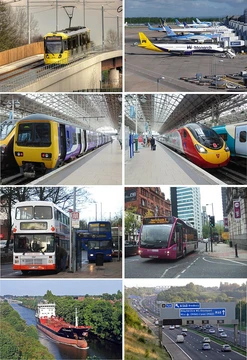
Freight transport
Physical process of transporting commercial goods and cargo.

Freight transport, also referred to as freight forwarding, is the physical process of transporting commercial products, merchandise, goods, and cargo. The term shipping originally referred to transport by sea but in American English has been extended to refer to transport by land or air. Logistics, a term borrowed from the military environment, is also used in the same sense.
- field
- Transportation and logistics
- known_for
- Physical movement of commercial goods by sea, land, air, and multimodal methods
Lore & Background
Initial human civilization relied heavily on domesticated animals such as horses, camels, and donkeys to transport goods. improved efficiency by allowing carts and carriages that animals could pull. The Romans built a vast network of roads facilitating trade across their empire. Transport along the Silk Road was generally done through caravans equipped with camels, with traders passing goods to others along different legs of the journey. During the Industrial Revolution, the midlands of England saw a sophisticated canal system and railway systems that began with horse-drawn carts and later switched to steam-powered trains. Presently, autonomous vehicles have been trialed to reduce labor costs, and robots designed to automate the 'last-mile delivery' stage have also been considered.
Reader's Guide
Freight transport is significant as the backbone of global trade, enabling the movement of goods across vast distances. Merchant shipping carries 80–90% of international trade and 60–70% by value. The industry has evolved from animal-drawn carts and Roman roads to steam-powered trains, canals, and specialized air cargo. The rise of integrated digital marketplaces is enabling small and medium-sized enterprises to access international supply chains through Less than Container Load and multimodal solutions. Incoterms published by the International Chamber of Commerce are accepted worldwide for interpreting common trade terms such as Free on Board, Cost and Freight, and Cost, Insurance and Freight. Door-to-door shipping offers a hassle-free option including all shipping, handling, import, and customs duties. The legacy of freight transport lies in its continuous adaptation—from prehistoric animal caravans to autonomous vehicles and digital platforms—facilitating global commerce and economic development.
Did You Know?
- In 2015, 70% of worldwide freight transport tonne-kilometers were by sea.
A Journey Through Millennia
Long before engines or railways, human civilizations depended on the strength of domesticated animals—horses, camels, and donkeys—to move their goods across landscapes. marked a turning point, enabling carts and carriages that multiplied what a single beast could haul. Centuries later, the Roman Empire laid down an extensive network of roads that stitched together its cities and made overland trade far more practical. Along the legendary Silk Road, caravans of camels carried merchandise from trader to trader; no single merchant typically traversed the entire route, instead handing goods off at successive legs. In England, the Industrial Revolution reshaped freight entirely: the Midlands grew a sophisticated canal system for long-distance cargo, while railways evolved from horse-drawn carts into steam-powered trains. Today, autonomous vehicles and last-mile delivery robots are being trialled to trim labour costs and automate the final stretch of every journey.
The Global Scale of Movement
The sheer volume of goods moving across the planet is staggering. Sea shipping dominates this picture, accounting for 70 per cent of the total, followed by road at 18 per cent, rail at 9 per cent, inland waterways at 2 per cent, and air at a mere fraction under 0.25 per cent. Each mode carries its own trade-offs: ground transport is generally cheaper than flying but pricier than shipping by sea, particularly in developing nations where inland infrastructure lags. Air freight, while the quickest option for long distances, remains the costliest. On rivers and canals, barges handle bulk cargo, while a nation's entire seafaring fleet and crew are collectively known as its merchant navy or merchant marine.
Where Modes Converge
Modern freight rarely travels by a single method from start to finish. In multimodal transport, cargo is handed between different modes of movement at transport hubs—train stations, airports, and similar interchanges—under one unified contract, even though at least two distinct modes are involved. The goods themselves need not be containerized for this to work. Intermodal transport takes the concept a step further by relying on standardized containers that slide seamlessly between ship, rail, plane, and truck. A shipper might, for instance, coordinate ground and air legs to deliver an item overseas, with the intermodal route planned from the manufacturer's door to the recipient's doorstep. Door-to-door shipping, whether domestic or international, aims to keep cargo on the same piece of equipment throughout, sidestepping trans-loading, cross-docking, and interim storage. International door-to-door service, offered by many carriers, bundles all shipping, handling, import, and customs duties into a single quoted price, shielding customers from the separate fees—customs charges, import taxes, tariffs—that can otherwise inflate the base transport cost substantially before a package ever arrives.
The Language of Commerce
Behind every shipment lies a shared vocabulary that keeps international trade orderly. The Incoterms, published by the International Chamber of Commerce, are recognized by governments, legal authorities, and practitioners around the world as the standard for interpreting the most frequently used terms in cross-border trade. Among the best-known are Free on Board (FOB), Cost and Freight (CFR, also written C&F or CNF), and Cost, Insurance and Freight (CIF). In day-to-day operations, the phrase "best way" signals that the shipper will select whichever carrier offers the lowest rate, though practical considerations such as superior insurance coverage or a faster transit window can tip the decision toward a higher-bid option. The freight industry is also undergoing a digital transformation, with logistics marketplaces emerging to connect shippers and carriers more efficiently. Meanwhile, the terminology itself has evolved: "shipping" once meant exclusively sea transport, but in American English it now encompasses land and air carriage, while the military-borrowed word "logistics" has entered common usage to describe the same broad process of moving commercial goods.
Frequently Asked Questions
What is Freight transport in the Transportation 1-24 series?
Freight transport, sometimes called freight forwarding, is the hands-on process of physically moving commercial goods, merchandise, and cargo from one point to another. It sits squarely within the transportation and logistics field as the core act of getting products where they need to go.
What methods does Freight transport use to move goods?
It covers sea, land, air, and multimodal combinations, meaning a single shipment can hop between different modes of travel. The entry highlights that the physical movement across those four categories is what defines the concept.
How is Freight transport different from the word 'shipping'?
The term shipping originally described only sea-based transport, but in American English it has broadened to include land and air movement as well. Freight transport is the more precise, field-specific label for the same underlying activity.
Where does the term 'logistics' fit in relation to Freight transport?
Logistics is a military-origin word that has been borrowed into commercial use to describe the same planning and execution of goods movement. In the series context it functions as a synonym for the broader operational side of freight transport.
Why is Freight transport considered a key entry in the Transportation 1-24 list?
It is the fundamental physical act behind every commercial supply chain, making it the backbone that other logistics and planning concepts build upon. Without the actual movement of cargo by sea, land, or air, the entire commercial transport framework has no execution layer.
More in Transportation 1-24
Elsewhere in the Transportation universe
Spotted an error? Know more?
This is a living reference — every entry is fact-audited, and reader corrections feed straight into our audit queue. Suggest an edit · See this site's audit record