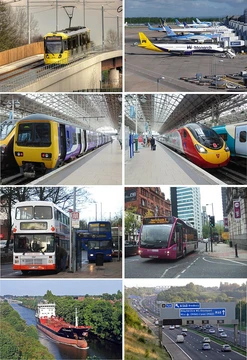
Road
A thoroughfare for traffic, distinct from streets and stroads.

A road is a thoroughfare from one place to another, primarily used for movement of traffic. Many roads are paved. The words 'road' and 'street' are commonly considered interchangeable, but in urban design roads differ from streets, whose primary use is local access, and from stroads, which combine features of both. Roads include many types such as parkways, avenues, controlled-access highways, tollways, highways, local roads, public roads, and private roads. Primary features include lanes, sidewalks, roadways, medians, shoulders, verges, bike paths, and shared-use paths.
- definition_used
- Line of communication open to public traffic, primarily for road motor vehicles, using a stabilized base other than rails or air strips
Lore & Background
Historically, many roads were simply recognizable routes without formal construction or maintenance. In 500 BC, Darius I the Great started an extensive road system for the Achaemenid Empire, including the Royal Road connecting Sardis to Susa, which fell into disuse long before Roman times. In the 8th century AD, many roads were built throughout the Arab Empire, though there is no established evidence that the most sophisticated in Baghdad were paved with tar derived from petroleum through destructive distillation.
Reader's Guide
The Roman Empire's extensive paved network supported military campaigns and set a standard for durability. By the late 19th century, engineers began catering to cyclists with separate lanes. The 20th century saw roads built for tourism and job creation, exemplified by the Great Dolomite Road and the Strada Costiera in Italy. Roads remain essential infrastructure, with subgrade, engineered right-of-way, and pavement construction overcoming geographic obstacles.
Did You Know?
- While some sources claim that in the 8th century AD, roads in Baghdad were paved with tar derived from petroleum through destructive distillation, there is no established evidence to confirm this.
Ancient Foundations & Imperial Road-Building
From the earliest days of organized civilization, the construction of reliable road networks served as a hallmark of imperial power. The Persians laid out an extensive system of Royal Roads spanning their vast territory, while the Aztec and other early empires similarly adopted standardized road systems. The Roman contribution proved particularly transformative: faced with muddy tracks that slowed the movement of large armies, Roman engineers developed solid, long-lasting roads built on deep roadbeds of crushed stone. This design allowed water to drain away rather than pooling into clay mud, keeping surfaces passable. Centuries later, the Islamic Caliphate introduced tar-paved roads in Baghdad, representing another leap in surface technology. In 18th-century West Africa, the Ashanti Empire maintained a network of well-kept roads linking its capital to subordinate territories, while the kingdom of Dahomey constructed toll roads that doubled as instruments of taxation. King Kpengla's Royal Road, stretching from Abomey through Cana to Ouidah, exemplified how road infrastructure could project political authority across a region.
The Turnpike Revolution & Early Road Governance
Before the 18th century, road construction saw little meaningful innovation beyond attempts to revive Roman techniques. That changed when the British Parliament began enacting a series of measures granting local justices the authority to install toll-gates along public highways in return for professional maintenance. The underlying model was elegant: trustees pooled resources from the parishes through which a highway passed, supplemented those funds with tolls collected from travelers outside those parishes, and directed the combined revenue toward maintaining the main route. This framework spread rapidly as communities sought to improve commercial flow through their portion of a county. Yet the quality of early turnpike roads remained inconsistent. Technologies for handling geological obstacles, drainage, and weather damage were still in their infancy, and meaningful construction improvements came slowly, initially through the work of individual surveyors like John Metcalf in 1760s Yorkshire.
Pioneers of Modern Road Engineering
By the late 18th and early 19th centuries, a new generation of engineers transformed road building from craft to science. His philosophy centered on drainage: he insisted that a good road needed solid foundations, effective water management, and a smooth convex surface so that rainwater could flow quickly into roadside ditches. He recognized that rain, not traffic, was the primary destroyer of road surfaces. His method layered large rocks beneath a course of smaller gravel, with the critical insight that the lower layer's purpose was to spread the weight of the road and its traffic evenly into the ground rather than acting as a self-supporting structure. The upper layer then provided a smooth running surface while protecting the larger stones beneath. Thomas Telford and John Loudon McAdam further advanced these principles, and British builders gradually learned to select clean stones for surfacing while excluding vegetable matter and clay, yielding more durable roads.
The Practical Landscape of Road Transport
Road transport today encompasses an extraordinary range of vehicles and purposes, broadly divided into the movement of goods and the movement of people. In many countries, licensing requirements and safety regulations maintain a clear separation between these two industries. The vehicles that traverse roads span the full spectrum of mobility: bicycles, automobiles, buses, trucks, and even animals such as horses and oxen. Cargo logistics depend on multiple variables—the distance involved, the weight and volume of each shipment, and the nature of the goods themselves. A small, lightweight delivery over a short distance might be handled by a van or pickup truck, while larger shipments call for a full truck. In some regions, horse-drawn carriages or donkey carts still carry freight, and bike couriers handle small packages and documents in dense urban areas. Passenger transport ranges from mass transit buses to specialist vehicles like ambulances and locally available cycle rickshaws. The infrastructure supporting all this movement has evolved from two-lane local roads with at-grade intersections to controlled-access highways where all cross traffic is grade-separated, with defined lanes and signage as standard features.
Frequently Asked Questions
What is a road?
A road is a public thoroughfare built on a stabilized surface, designed primarily for motor vehicle traffic moving between locations. It is distinct from rail lines or air strips and serves as a line of communication open to the public.
How does a road differ from a street?
Although people often use the two words interchangeably, urban design treats them as serving different purposes: roads are built for through-traffic movement, while streets are oriented toward local access to nearby properties. A stroad blends both roles and is generally seen as a design compromise.
What types of roads exist?
Roads span a broad range of categories, including parkways, avenues, controlled-access highways, tollways, local roads, and both public and private roads. Each category is tailored to different traffic volumes, speed expectations, and access needs.
What are the main physical features of a road?
Common components include lanes, sidewalks, medians, shoulders, verges, and bike paths. Shared-use paths may also be incorporated depending on the road's design and local regulations.
What is a stroad and how does it relate to roads?
A stroad is a hybrid thoroughfare that combines the through-movement function of a road with the local-access function of a street. In urban design it is typically regarded as a compromise that serves neither purpose optimally.
More in Transportation 25-34
Elsewhere in the Transportation universe
Spotted an error? Know more?
This is a living reference — every entry is fact-audited, and reader corrections feed straight into our audit queue. Suggest an edit · See this site's audit record