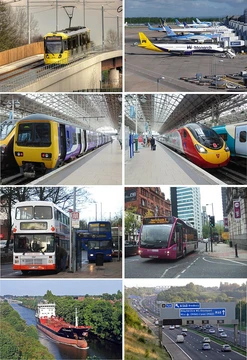
Public transport
Shared passenger transport on fixed routes and schedules.

Public transport, also known as public transportation, mass transit, or simply transit, refers to forms of transport made available for use by the general public. These systems typically operate on fixed routes and schedules, charging a standardized fare intended to cover operating costs, often supplemented by public funding. There is no universally fixed definition of which modes are included, though buses, railways, trams, rapid transit, passenger trains, and ferries are common examples.
- First country to make all public transpo
- Luxembourg, March 2020
Lore & Background
The earliest public transport was water transport, with ferries appearing in Greek mythology. Historical forms include stagecoaches traveling fixed routes between coaching inns and horse-drawn boats on European canals from the 17th century. Boston built the first U.S. In March 2020, Luxembourg abolished fares for trains, trams, and buses, becoming the first country to make all public transport free.
Reader's Guide
Public transport systems vary significantly by region due to historical, geographic, and economic factors. In Japan, many urban transit networks are operated by profit-oriented private companies, often integrated with real estate development, a model cited for financial sustainability. In North America, mass transit is most commonly operated by municipal or regional transit authorities, funded through fares, local taxes, and subsidies. In Europe, both state-owned enterprises and private operators participate, often under competitive contracting. In developing nations, research indicates that the service marketing mix significantly influences customer satisfaction, which drives ridership intention. Seven criteria estimate usability: speed, comfort, safety, cost, proximity, timeliness, and directness. Many individuals are motivated by direct cost and convenience, while loss of control, overcrowding, and phobias may discourage use. Actual travel time becomes a lesser consideration when predictable and comfortable. The transport hub facilitates multimodal travel. Public transport remains essential for urban mobility, environmental goals, and equitable access.
Did You Know?
- The earliest public transport was water transport, with ferries appearing in Greek mythology.
- Luxembourg became the first country to make all public transport free in March 2020.
Frequently Asked Questions
Who is Public transport?
Public transport is the collective name for shared passenger systems—buses, trams, trains, ferries, and rapid transit—that run on set routes and timetables and are open to anyone willing to pay a standard fare. There is no single universal list of which modes qualify, but the core idea is public availability rather than private ownership.
What are Public transport's powers or role?
Its primary function is to move large numbers of people along fixed corridors on a predictable schedule, with fares structured to offset daily operating expenses. In most countries the system also leans on government subsidies to keep routes affordable and running, even when ridership alone would not cover the cost.
How does Public transport's story end?
There is no single ending; the system is an ongoing, evolving infrastructure rather than a narrative with a final chapter. That said, a landmark turning point came in March 2020 when Luxembourg became the first nation to remove all fares from its bus, tram, and rail network, effectively rewriting the traditional fare-based model.
Why is Public transport important?
It gives people who do not own a car a reliable way to commute, shop, and travel, which reduces congestion, cuts per-capita emissions, and keeps communities connected. Because it operates on shared routes and schedules, a single vehicle can serve dozens or hundreds of riders, making it one of the most efficient ways to move a population.
What is the most-searched milestone in Public transport's timeline?
Fans and transit enthusiasts most often point to Luxembourg's March 2020 decision to make every bus, tram, and train ride free for all residents. It was the first time a sovereign state eliminated fares across its entire public network, and it sparked worldwide debate about whether other cities and countries could follow suit.
More in Transportation 25-34
Elsewhere in the Transportation universe
Spotted an error? Know more?
This is a living reference — every entry is fact-audited, and reader corrections feed straight into our audit queue. Suggest an edit · See this site's audit record